

Small enterprises have a tendency to deal with small teams and time limits. Marketing can be easily stressful when it is carried out manually. All the emails, social media posts, customer follow-ups, and lead tracking have to be monitored at all times.
This is where Marketing automation comes in. It assists companies with automated, repetitive marketing data and technology, and concentrates on their strategy and development. Even a small team can perform effective marketing campaigns with the help of the right tools.
This beginner’s guide will cover what marketing automation is, why it is important to small businesses, and provide a starting point for using it.
What Is Marketing Automation?
Automation in marketing is the technique of using software and technology to automate marketing. Such activities may involve email campaigns, customer follow-ups, scheduling social media, and lead tracking and analytics.
The system does not require them to do everything manually, but rather carries out functions according to preset rules. To take an example, when a person registers on your site, he/she can automatically get a series of welcome emails.
Automation assists companies in sending the appropriate message to the appropriate individuals at the appropriate moment. It also maintains the marketing without having to do it manually all the time.
The Importance of Marketing Automation to the Small Business
Small businesses are usually low-resource. Automation of marketing assists in saving time, and marketing work is made more efficient. Marketing automation typically yields large results at companies that utilize it. Others record an average of 34% growth in revenue following the introduction of automation.
Lead generation and conversions are also enhanced through automation. Automated campaigns by small businesses have resulted in 18% more leads and approximately 12% higher conversion rates.
It is these factors, among others, that make marketing automation so valuable to small businesses.
1. Saves Time and Effort
Automation handles repetitive tasks like emailing, updating contact lists, and scheduling posts, freeing teams to focus on creative and strategic work. Studies show that it can save about 25% of the time spent on manual data entry.
2. Improves Lead Management
Marketing automation is used to follow leads in the sales funnel and nurture them. Automated follow-ups will help to make sure that the potential customers get the information at the right time and remain active.
3. Efforts Customized Marketing
With the help of automation tools, businesses can divide their target audiences in terms of behavior, location, or buying history. It can now send personalized messages to various groups of customers.
4. Increases Marketing ROI
Automation enhances the efficiency of campaigns, and the cost of marketing is minimized. Organizations that are automation-intensive tend to have more returns on their marketing investment.
5. Helps Small Teams Compete
By automation, small teams could currently perform tasks similar to those of the larger marketing departments. In automated workflows, two individuals are able to handle campaigns, which used to need a complete team.
Important Marketing Automation Characteristics
Unless you are familiar with automation, it is worth knowing the key features that are offered in the majority of the tools.
Email Marketing Automation
One of the most widespread features is the automated email sequences. Firms are able to automatically send welcome e-mails, promotions, and follow-up messages.
Lead Scoring and Tracking
The usage patterns of users are monitored by automation platforms, including clicks on websites and emails. It is then possible to score and give leads to the sales teams.
Social Media Scheduling
With the help of automation tools, businesses can plan their posts on social media. This ensures there is content that is kept regularly without manual posting every day.
Customer Segmentation
Automation programs cluster the customers on the basis of information. The businesses can then make relevant campaigns to particular segments.
Analytics and Reporting
Robotics systems give comprehensive campaign reports. The open rates, conversions, and engagement allow businesses to make subsequent campaigns better.

Examples of Marketing Automation Workflows
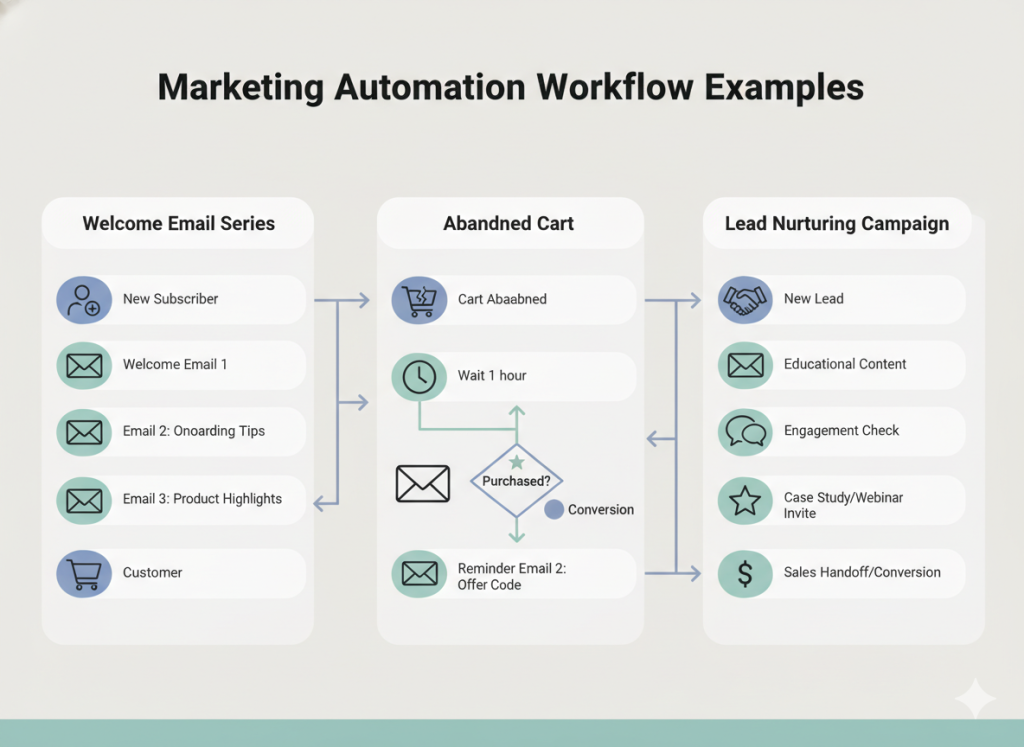
Marketing automation is most effective when it is a systematic workflow. These are some of the simplistic examples.
Welcome Email Series
Once a user subscribes to your newsletter, they will get a series of emails that will introduce your brand.
Abandoned Cart Emails
The system sends a reminder email if a customer leaves items in their cart but doesn’t complete the transaction.
Lead Nurturing Campaigns
Before they are ready to make a purchase, new leads are gradually exposed to useful content.
Customer Retention Campaigns
Automation is to send loyalty rewards, feedback requests, or product recommendations to existing customers. Such workflows maintain a consistent form of communication and establish stronger relationships with customers.
The Way to Begin Marketing Automation in Your Small Business
Automation does not necessarily need to be complex to begin with. Follow these simple steps.
1. Define Your Marketing Goals
The first step is to discover what you desire. It can be lead creation, customer interaction, or sales expansion.
2. Choose the Right Tools
Choose marketing automation software that satisfies your budget and business requirements. Numerous applications are easy to use and integrate.
3. Develop Your Customer Base
Gather customer information using web forms, newsletters, or CRM applications. This information is used to develop one-on-one marketing efforts.
4. Begin With Basic Automation
Start with simple processes (welcome messages or lead follow-up). With experience, you will be able to develop more complex automation plans.
5. Monitor and Improve Performance
Keep track of campaign performance. Analytics help you know what works and change your strategy accordingly.
Common Mistakes to Avoid
Marketing automation is very potent, but it should be applied sparingly by businesses.
Over-automation
Excessive automated messaging is artificial. It is best that you maintain a human tone of communication.
Poor Data Management
Automation is based on precise customer information. Relevant messaging may also be caused by poor data quality.
Lack of Strategy
Automation tools go well with a defined marketing strategy. Automation is not likely to work without a strategy.
Marketing Automation: The Future
The fast-growing marketing automation is being transformed by artificial intelligence and complex analytics. These kinds of technologies may allow companies to deliver a more personal experience and make superior decisions.
These days, automation tools are also cheap and affordable. This translates to the reality that small firms can compete with the bigger firms because they are capable of coming up with smarter marketing strategies.
Final Thoughts
Big companies are no longer the only ones that are automating their marketing efforts. It has turned into a necessary tool for small businesses that prefer to develop effectively.
Automation helps businesses to save on time, enhance customer relations, and boost marketing. According to research, automation can greatly increase leads, conversions, and revenue, provided it is utilized properly.
The trick is that one should not begin with anything complicated. Target fundamental processes, work on the outcomes, and develop a more complex automation plan.
Faqs
A program that makes it possible to automate marketing processes is known as marketing automation. This is through email, the utilization of social media, and tracking and following up on customer leads. It assists small businesses in time-saving and implementing campaigns that do not require much manual work.
Small businesses, which have limited resources for marketing, can benefit from the use of marketing automation. It enhances campaign performance and customer and lead follow-ups. The smaller firms would also be able to compete with the larger organizations through automation and would be capable of making smarter and more consistent marketing strategies.
Email campaigns, lead nurturing, planning posts on social platforms, customer segmentation, following up on emails, and tracking campaign success are some of the activities that can be automated by small businesses. The results are also tested through the help of automation to enhance marketing activity due to real customer behavior.
Small businesses can now afford marketing automation. The majority of the tools are customizable with regard to pricing and plan. The basic automation can enable the business to begin with the basic automation and upgrade their automation as their marketing requirements and their financial capacities broaden.
The initial steps that small businesses should take are the definition of marketing goals, the choice of a sufficient automation tool, and customer data collection. Simple and less complex tasks, such as welcome mail or follow-ups, should be started with and enhanced with automation over time.